
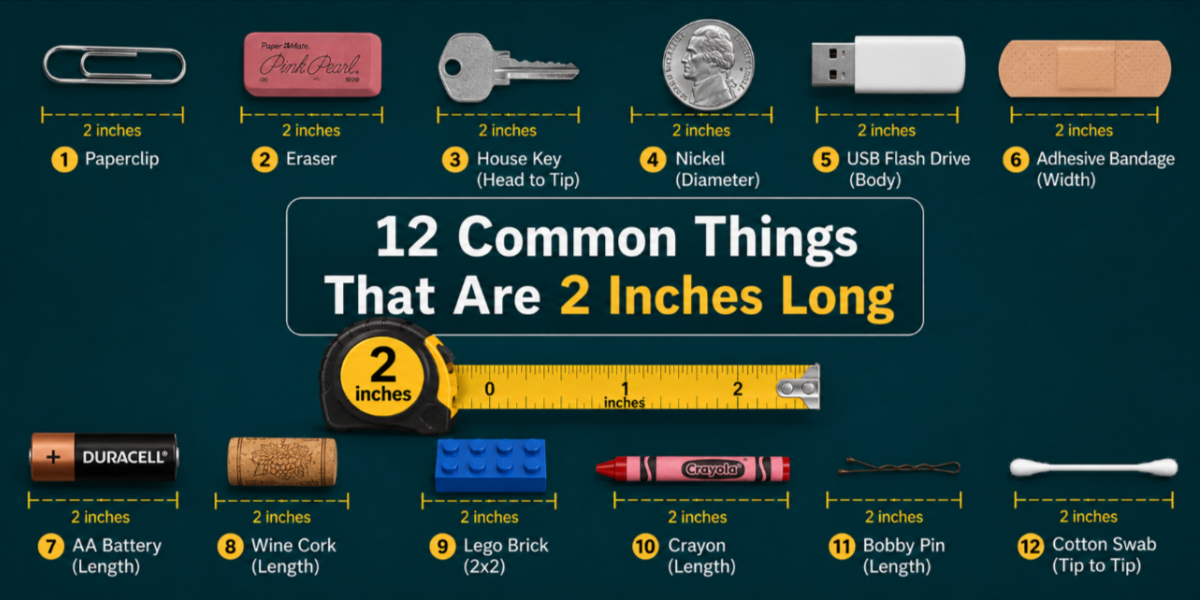
Understanding measurements can sometimes feel confusing, especially when you do not have a ruler nearby. One of the most common small measurements people try to imagine is 2 inches long. Whether you are shopping online, working on a DIY project, helping children learn measurements, or simply curious about object sizes, knowing what 2 inches looks like in real life can be extremely helpful.
Two inches may sound small, but many everyday objects around your home, office, kitchen, or school are close to this size. Real-life examples make measurements easier to understand because our brains remember familiar objects better than numbers alone. Instead of trying to imagine a ruler, you can simply think about common items you use every day.
In this detailed guide, you will learn about common things that are approximately 2 inches long, along with practical explanations and helpful comparisons. By the end of this article, you will have a much clearer understanding of this measurement and how to estimate it without needing any measuring tools.
How Long Is 2 Inches?
Before looking at examples, it helps to understand the actual size of 2 inches. In the metric system, 2 inches equals approximately 5.08 centimeters. That means it is slightly longer than the width of many small household objects but still compact enough to fit comfortably in your hand or pocket.
2 inches=5.08 centimeters2\text{ inches} = 5.08\text{ centimeters}2 inches=5.08 centimeters
For many people, visualizing 2 inches becomes easier when comparing it to finger widths. For example, the width of two adult thumbs placed side by side is often close to 2 inches. Another simple comparison is the length of a small office supply item such as a paper clip or matchstick.
Even though 2 inches is not very large, this measurement appears frequently in daily life. Small electronics, craft materials, kitchen accessories, keys, and decorative items often fall within this size range.
12 Common Things That Are 2 Inches Long
1. A Standard USB Flash Drive
A standard USB flash drive is one of the easiest ways to imagine 2 inches in length. Many compact USB drives are designed to be small and portable, usually measuring between 1.8 and 2.5 inches long. Because people commonly carry USB drives for storing files, photos, or school work, this example feels familiar to most readers.
When you hold a USB drive in your hand, you can quickly understand how compact 2 inches actually is. It is long enough to notice easily but still small enough to fit inside your pocket without taking much space. Some modern flash drives are even smaller, but traditional designs remain very close to the 2-inch mark.
This comparison is especially useful because USB drives are rectangular, making their length simple to picture mentally.
2. A Matchstick
A wooden matchstick is another excellent example of something close to 2 inches long. Standard matchsticks used in homes, restaurants, or camping kits are often around this size. Even though matchsticks are thin and lightweight, they provide a surprisingly accurate visual reference for small measurements.
Most people have seen or used matches at some point in their lives, which makes them easy to remember. If you imagine a single wooden matchstick lying on a table, you already have a rough idea of what 2 inches looks like.
Because matchsticks are straight and narrow, they also help people understand the difference between short lengths and slightly larger measurements like 4 or 5 inches.
3. A Large Paper Clip
Office supplies are often useful for measurement comparisons, and a large paper clip is one of the best examples of a 2-inch object. While smaller paper clips may measure around 1 inch, larger versions are commonly close to 2 inches long.
Paper clips are found in schools, homes, and workplaces worldwide, making them a universal size reference. If you have ever attached papers together using a large paper clip, you have probably already handled something very close to 2 inches in length.
One reason this example works so well is that paper clips have a simple shape that is easy to visualize. Their thin metal design allows people to focus directly on length without distractions.
4. Two Quarters Placed Side by Side
Coins are one of the most practical ways to estimate measurements because they are standardized in size. A single U.S. quarter has a diameter of just under 1 inch. When two quarters are placed side by side, their combined length becomes very close to 2 inches.
This comparison is helpful because coins are everyday objects that many people already carry in their wallets or pockets. Even if you are not using U.S. currency, the idea still demonstrates how small measurements can be estimated using simple objects.
Using coins as measurement references is common in photography, crafting, and online product comparisons because people instantly recognize their size.
5. A Small House Key
Many small house keys or cabinet keys measure around 2 inches long. While larger car keys can be longer, traditional metal keys often fit closely within this measurement range.
Keys are excellent examples because nearly everyone handles them daily. If you picture a small silver key in your hand, you can quickly estimate what 2 inches looks like without needing a ruler.
The size of a key also demonstrates how practical 2-inch objects can be. They are small enough to carry comfortably but large enough to grip easily.
6. A Golf Tee
A golf tee is another object commonly close to 2 inches long, especially shorter tee designs used for irons or practice shots. Golf tees are lightweight and narrow, but their length provides a clear visual guide for this measurement.
Even people who do not play golf have probably seen golf tees before. Their simple shape makes them easy to compare with rulers or other objects.
Golf tees also highlight how measurements can vary slightly depending on design. Some tees are longer, but shorter versions remain close to the 2-inch range.
7. A Domino Tile
A standard domino tile is usually around 2 inches long, depending on the set design. Dominoes are popular game pieces used worldwide, and their rectangular shape makes them useful for understanding measurements.
When you hold a domino tile, you can notice how compact but noticeable 2 inches really is. It is large enough to display numbers clearly while remaining small enough to fit several pieces inside one hand.
Because dominoes are solid and rectangular, they provide a more realistic sense of size compared to thinner objects like matchsticks or paper clips.
8. A Lip Balm Container
Many lip balm tubes or lip balm caps measure approximately 2 inches in height. These small personal care items are commonly carried in purses, backpacks, and pockets.
Lip balm containers are useful comparisons because they combine both height and width in a familiar object. People often underestimate how small 2 inches is until they compare it with something they use daily.
This example also shows how product packaging is designed to remain portable and convenient while still being easy to hold.
9. A Small Binder Clip
Small binder clips used for organizing papers are often close to 2 inches long. These clips are commonly used in offices and schools to hold documents securely together.
Because binder clips are slightly bulkier than paper clips, they help people understand how 2 inches can apply to thicker objects as well. Their metal handles and square shape create a strong visual reference.
Office supplies remain some of the easiest objects to use for learning measurements because they are standardized and widely available.
10. Half the Width of a Credit Card
A standard credit card measures about 3.37 inches wide. Half of that width comes fairly close to 2 inches.
3.372≈1.69 inches\frac{3.37}{2} \approx 1.69\text{ inches}23.37≈1.69 inches
Credit cards are one of the most recognizable size references in the world. Almost everyone has handled one at some point, making them extremely useful for estimating measurements.
This comparison is especially helpful because people often carry cards with them, even when they do not have access to measuring tools.
11. A Tealight Candle
A standard tealight candle often has a diameter close to 2 inches. These small candles are commonly used for decoration, relaxation, and home lighting.
Because tealight candles are circular, they provide a different perspective on measurements. Instead of thinking about straight lines, you can imagine the width of a small round candle sitting on a table.
This example is useful because it demonstrates that measurements apply to both length and diameter.
12. A Small Sewing Needle Packet
Small sewing needle packets often measure around 2 inches long. These packets are designed to stay compact while holding multiple needles safely inside.
Sewing kits are common in many homes, and their accessories are usually designed in convenient small sizes. A needle packet provides another simple example of how 2-inch objects appear in daily life.
Because sewing supplies are portable and compact, they help reinforce the idea that 2 inches is small but still functional.
Why Learning Real-World Measurements Is Helpful
Understanding measurements through real-life objects is much easier than memorizing numbers alone. Many people struggle to picture inches or centimeters until they compare them with familiar items.
Knowing what 2 inches looks like can help with:
- Online shopping
- Home decorating
- School projects
- Crafting and DIY work
- Estimating object sizes
- Teaching children measurements
Real-world comparisons improve accuracy and help people make better decisions when buying or measuring items.
Final Thoughts
Although 2 inches may seem like a tiny measurement, it appears everywhere in everyday life. From paper clips and dominoes to USB drives and keys, many familiar objects fall close to this size range.
Learning these comparisons can make measurements feel much more natural and easier to understand. Instead of reaching for a ruler every time, you can simply picture one of the common objects mentioned in this guide.
The next time someone asks, “How long is 2 inches?” you will already have several practical examples ready to help explain it clearly.
Leave a Reply