
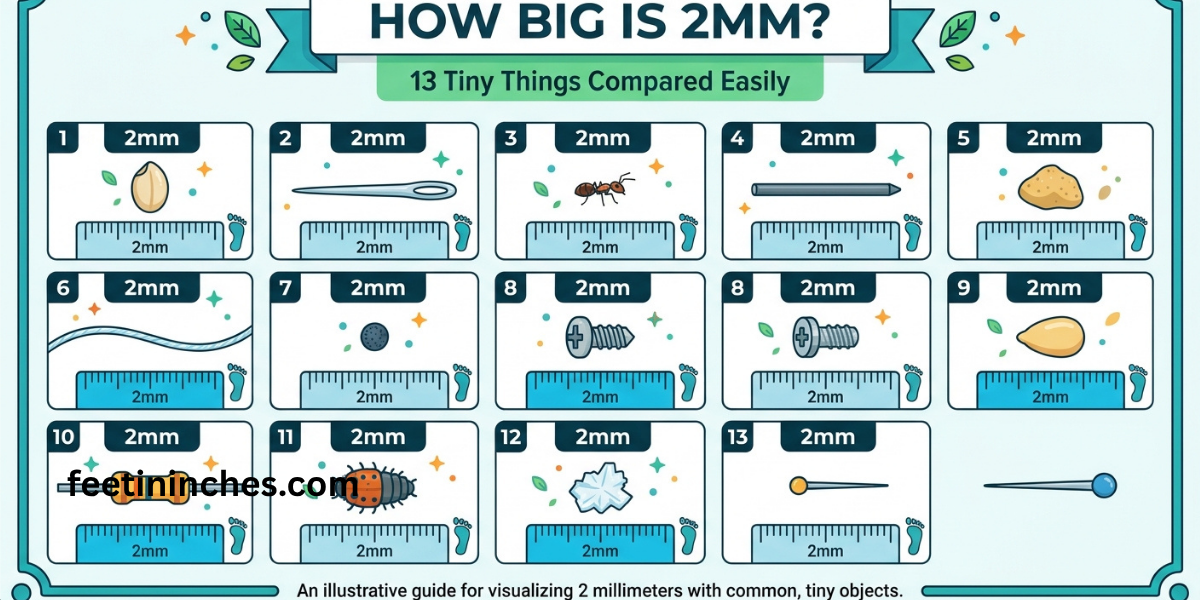
Two millimeters is a very small measurement. It is easy to overlook, yet it can make a noticeable difference when measuring jewelry, screws, wires, paper, or other small objects.
Imagine trying to identify a tiny gap between two tiles. Or perhaps you need to check whether a small screw will fit into a hole. You might see a product listed as 2mm thick and wonder what that actually looks like.
The challenge is simple. Most people understand inches or centimeters better than millimeters. Without a familiar object for comparison, a measurement this small can feel almost impossible to visualize.
Two millimeters equals 0.2 centimeters, approximately 0.079 inches, or 2,000 micrometers. It is slightly less than one-tenth of an inch. A United States nickel coin, which is 1.95mm thick, provides an excellent real-world comparison. The US Mint publishes this measurement in its official coin specifications. Check the US Mint’s coin measurements.
In this guide, you will discover 13 tiny things that help you picture 2mm. You will also learn how to measure this distance, understand its thickness, and convert it into other units.
How Big Is 2mm Exactly?
Two millimeters is a short distance on the metric scale. There are 10 millimeters in one centimeter, so 2mm equals one-fifth of a centimeter.
Here are the most useful conversions.
| Measurement unit | Equivalent to 2mm |
|---|---|
| Millimeters | 2mm |
| Centimeters | 0.2cm |
| Meters | 0.002m |
| Inches | 0.07874 inches |
| Micrometers | 2,000 micrometers |
| Fractions of an inch | Approximately 5/64 inch |
The inch conversion is rounded for everyday use. The exact relationship is based on 25.4 millimeters per inch.
Is 2mm Bigger Than 1/16 Inch?
Yes. Two millimeters is approximately 0.07874 inches, while 1/16 inch equals 0.0625 inches.
Therefore, 2mm is about 0.01624 inches thicker or longer than 1/16 inch.
This difference may seem small, but it matters when choosing precision parts. A drill bit, screw, or fitting that differs by even a small amount may not fit correctly.
Is 2mm the Same as 0.2cm?
Yes. Two millimeters equals exactly 0.2 centimeters.
To convert millimeters into centimeters, divide the measurement by 10.
For example, 5mm equals 0.5cm, while 20mm equals 2cm. This simple relationship makes metric conversions easy to remember.
13 Tiny Things That Help You Visualize 2mm
The easiest way to understand a tiny measurement is to compare it with objects you recognize.
Some items below have standardized dimensions close to 2mm. Others are approximate examples that vary by brand, material, or natural size.
Pay attention to the dimension being compared. An object’s thickness, diameter, width, and length describe different measurements.
1. The Thickness of a US Nickel Coin
A US nickel is one of the most useful physical references for 2mm.
According to the United States Mint, a standard nickel measures 1.95mm thick. That makes it only 0.05mm thinner than the measurement you want to visualize.
Place the coin on a flat surface and look at its edge. The narrow side gives you a close impression of what 2mm looks like.
Remember that the coin’s diameter is much larger. Its diameter measures 21.21mm, so comparing its width with 2mm would give you the wrong idea.
What this comparison teaches you: Two millimeters is roughly the thickness of a US nickel.
This is a useful reference if you live somewhere that US coins are available. Other countries have different coin dimensions, so do not assume every five-unit coin has the same thickness.
2. The Thickness of a US Dollar Coin
A US dollar coin provides an even closer comparison.
The US Mint lists the thickness of a standard dollar coin at 2.00mm. This matches the target measurement exactly in its published specification.
The coin’s thickness is easy to confuse with its diameter. Its diameter measures 26.49mm, which is more than thirteen times its thickness.
That difference illustrates an important point. A round object can be wide while remaining extremely thin.
What this comparison teaches you: A standard US dollar coin has a specified thickness of 2mm.
You can use the edge as a reference, although the official measurement is more reliable than judging it by sight alone.
Source: Official US Mint coin specifications.
3. The Thickness of a US Penny
A US penny is thinner than 2mm.
The US Mint lists the standard penny’s thickness as 1.52mm. This makes it 0.48mm thinner than the target measurement.
Place the penny beside a nickel or dollar coin. You can compare their edges to see how small differences in thickness appear.
The penny is not an exact substitute for 2mm. However, it is useful for understanding a measurement that falls between a very thin coin and a thicker coin.
What this comparison teaches you: A penny’s edge is noticeably thinner than 2mm, although the difference is still small.
This example also shows why checking official dimensions is better than assuming all coins have similar thicknesses.
4. A 2mm Screw Shaft
Small screws often use metric sizing, making them useful examples of millimeter measurements.
An M2 screw has a nominal thread diameter of 2mm. The letter M identifies a metric screw thread, and the number indicates its nominal diameter.
However, an M2 screw is not necessarily 2mm thick at every point. Thread roots and crests have different diameters, and the screw’s head may be much wider.
If you compare an M2 screw with another small screw, examine the shaft and threads rather than the head.
What this comparison teaches you: Two millimeters can describe the nominal diameter of a tiny mechanical component.
This reference is useful when working with electronics, model kits, small appliances, and hobby projects. Always check the screw specifications before selecting a replacement.
5. A 2mm Drill Bit
A drill bit marked 2mm is designed around a nominal diameter of 2 millimeters.
Look at the narrow cutting section near its tip. That section gives you a practical reference for the measurement.
Do not compare the bit’s full length with 2mm. Drill bits can be several centimeters long, even when their cutting diameter is only 2mm.
Also, avoid using a drill bit as a measuring tool. Its sharp edges can cause injuries, and a ruler or caliper is safer for checking dimensions.
What this comparison teaches you: Two millimeters is a realistic diameter for a small drill bit.
This example is especially useful for people interested in woodworking, electronics, jewelry making, and small repair projects.
6. A 2mm Mechanical Pencil Lead
Most familiar mechanical pencils use lead sizes such as 0.5mm, 0.7mm, or 0.9mm. Some drawing and drafting pencils use 2mm lead.
A 2mm lead is much thicker than the fine lead used in many everyday writing pencils.
You can compare its diameter with a thinner pencil lead. The difference becomes easier to notice when you place both against a light background.
The lead’s diameter is the important dimension here. Its length may be several centimeters, but that does not affect the thickness comparison.
What this comparison teaches you: A 2mm pencil lead has a diameter four times that of a 0.5mm lead.
This is a useful example for artists, technical illustrators, and people who use drafting pencils.
7. A Small Mustard Seed
Some mustard seeds measure around 1mm to 2mm across, depending on the variety.
Their small, rounded shapes make them useful for visualizing millimeter-scale objects. A seed near the upper end of that range can help you picture a diameter close to 2mm.
However, mustard seeds are natural objects. Their dimensions vary, and not every seed will match the measurement.
Place a seed beside a ruler with millimeter markings if you want to check its approximate size. A magnifying glass can make the comparison easier.
What this comparison teaches you: A mustard seed can be close to 2mm across, but it is not a standardized measuring reference.
This example helps connect a technical measurement with something found in an ordinary kitchen.
8. A Small Ant
Some small ant species have body lengths around 2mm. Other ants are much larger.
This makes ants an interesting natural comparison, but species matter. An ant measuring 2mm from head to abdomen is not necessarily 2mm wide.
Their bodies also contain several sections, including the head, thorax, and abdomen. You need to identify the exact endpoints before comparing an ant’s length with a measurement.
Because ants move quickly, they are not practical measuring tools. A photograph with a scale is more useful for checking their size.
What this comparison teaches you: Some tiny ants can measure approximately 2mm long.
Treat this as a visual estimate rather than an exact reference. Natural variation makes insects less reliable than standardized objects.
9. A Piece of 2mm Craft Cord
Craft cord comes in many thicknesses, including products sold with a nominal 2mm diameter.
A round cord makes it easier to understand diameter because the measurement runs across the circular cross-section.
Lay the cord on a table and compare its width with a millimeter ruler. Make sure you measure across the cord rather than along its length.
Soft cord can flatten under pressure. Some products may also have slightly different dimensions because of their weave or material.
What this comparison teaches you: A 2mm cord is a useful example of a narrow, round object.
This reference can help with jewelry, macrame, sewing projects, and decorative crafts. Check the manufacturer’s stated diameter before purchasing cord for a precise fit.
10. A 2mm Tile Spacer
Tile spacers help installers maintain consistent gaps between tiles.
A spacer labeled 2mm is designed to create a nominal gap of 2mm between adjacent tiles. Its purpose is to keep spacing consistent during installation.
The spacer’s body may have other dimensions, so do not assume its entire width or height equals 2mm.
You can place a spacer next to a ruler to understand the size of the intended gap. This is often easier than trying to visualize a narrow space between two large tiles.
What this comparison teaches you: Two millimeters can describe a small, controlled gap rather than the size of an object.
This is useful when learning about bathroom tiles, kitchen backsplashes, flooring, and other home improvement work.
11. A Small Jewelry Bead
Jewelry beads are available in many sizes, including beads with a nominal diameter of 2mm.
A bead of this size looks tiny beside common beads measuring 6mm or 8mm. Its small diameter makes it suitable for delicate jewelry designs.
However, bead size varies by material and manufacturer. A bead made from glass, metal, wood, or a natural stone may have slightly different dimensions.
Check the product description before ordering. Some listings give the hole diameter rather than the outside diameter, and these measurements are not interchangeable.
What this comparison teaches you: A 2mm bead provides a useful example of a tiny round object.
This reference is especially helpful when choosing jewelry findings, seed beads, and small decorative components.
12. A Short Length of Wire With a 2mm Diameter
Some electrical and craft wires have diameters close to 2mm. The exact size depends on the wire type and specification.
For example, 12 AWG solid copper wire has a bare conductor diameter of approximately 2.05mm. That makes it close to 2mm, although the insulation adds extra thickness to an insulated wire.
This distinction matters. The copper conductor and the outside of the insulated wire are not the same measurement.
If you need wire for a repair, use the specified wire gauge or diameter. Do not rely on visual estimates when electrical safety is involved.
What this comparison teaches you: A wire with a conductor diameter near 2mm can provide a practical reference.
For technical work, always check the manufacturer’s specifications and follow the applicable electrical requirements.
13. A Thin Gap Between Two Objects
A 2mm gap is easier to understand when you see it between two solid surfaces.
Imagine two flat tiles separated by a narrow space. If the gap measures 2mm, it equals one-fifth of a centimeter.
This example is different from the others because the measurement describes empty space rather than a physical object.
You might encounter similar gaps in cabinet fittings, small machine parts, craft projects, and product assemblies.
A feeler gauge can help check narrow gaps. These tools contain thin metal blades with stated thicknesses. A 2mm gauge can help you verify a gap when the tool and application are suitable.
What this comparison teaches you: Two millimeters is a small but measurable distance between surfaces.
In practical work, this distinction can be more useful than comparing the size of two unrelated objects.
Quick Comparison Table: What Does 2mm Look Like?
The following table summarizes the examples and identifies the dimension being compared.
| Tiny thing | Relevant dimension | How closely it matches 2mm |
|---|---|---|
| US nickel | Thickness, 1.95mm | Very close |
| US dollar coin | Thickness, 2.00mm | Exact by specification |
| US penny | Thickness, 1.52mm | Thinner |
| M2 screw | Nominal thread diameter | Nominally 2mm |
| 2mm drill bit | Cutting diameter | Nominally 2mm |
| 2mm mechanical pencil lead | Lead diameter | Nominally 2mm |
| Mustard seed | Width or diameter | Approximate |
| Small ant | Body length | Approximate |
| 2mm craft cord | Diameter | Nominally 2mm |
| 2mm tile spacer | Intended gap | Nominally 2mm |
| Small jewelry bead | Outside diameter | Nominally 2mm |
| 12 AWG solid copper wire | Bare conductor diameter, about 2.05mm | Very close |
| Gap between two surfaces | Gap width | Exactly 2mm when measured |
The most dependable references are objects with published specifications or verified dimensions. Natural items and ordinary household materials provide useful visual comparisons, but their sizes can vary.
How Can You Measure 2mm Without a Specialized Tool?
You can estimate 2mm with a ruler that has millimeter markings. You do not always need digital equipment.
Here are three practical methods.
Method 1: Use a Metric Ruler
Find the zero mark on a ruler and identify the second millimeter mark after it.
The distance between those two marks is 2mm. Keep the ruler flat and view the markings directly from above to reduce reading errors.
This method works well for simple measurements involving paper, small objects, and craft materials.
Method 2: Use a Coin as a Reference
A US nickel measures 1.95mm thick, making it a useful physical comparison.
You can use its edge to understand how thin 2mm looks. However, a coin cannot confirm that another object measures exactly 2mm.
If you need a precise result, use a ruler or measuring instrument with suitable resolution.
Method 3: Use Digital Calipers
Digital calipers can measure small dimensions more precisely than ordinary visual estimation.
To measure an object’s thickness, place the appropriate jaws around it. Close them gently until they contact the surfaces without crushing or deforming the material.
Read the displayed measurement and check that the instrument is suitable for the required tolerance.
Calipers are useful for screws, beads, wires, small components, and workshop projects. They cost more than a basic ruler, so they are most worthwhile when you measure small objects regularly.
Why Guessing Can Lead to Errors
Two millimeters may look simple on paper, but small measurement errors can have practical consequences.
A screw might not fit its intended hole. A bead might not pass over a cord. A tile gap might look uneven.
Use a visual reference to understand the scale, then measure the actual object before making decisions that require precision.
Why Does a Difference of 2mm Matter?
Two millimeters can seem insignificant when compared with a large object. However, the same difference can matter greatly in small components.
In Jewelry and Crafts
Beads, cord, wire, and clasps must often fit together. A small difference in diameter can affect the finished design.
For example, a bead hole that is too narrow may not accept the cord you selected. Checking both measurements before purchasing materials can prevent wasted time.
In Home Improvement
Tile spacing and small fittings require consistent dimensions. A narrow gap can affect how parts align and how the finished work looks.
Always follow the installation instructions for the materials you use. A visual comparison cannot replace the specified measurement.
In Electronics and Mechanical Repairs
Small screws, connectors, and mounting holes may use metric dimensions. A component that appears almost the right size may still be unsuitable.
Check the part number and specifications before ordering replacements. For electrical work, follow the applicable safety standards rather than relying on an approximate size.
The broader lesson is that measurement matters most when two parts must fit together.
Common Mistakes When Visualizing 2mm
Avoid these common errors when estimating a tiny measurement.
Confusing Diameter With Thickness
A coin’s diameter measures across its face. Its thickness measures from one flat side to the other.
A coin can have a diameter of more than 20mm while remaining only about 2mm thick.
Assuming Every Small Object Measures 2mm
Seeds, insects, beads, wires, and cords vary in size. A familiar object is only a reliable reference when you know its actual dimensions.
Ignoring Insulation or Coatings
Wire insulation increases the outside diameter beyond the bare conductor. Paint, coatings, and protective layers can also change an object’s external dimensions.
Always check whether a specification describes the base material or the finished product.
Relying on a Photograph Alone
A photograph may make a small object look larger or smaller than it really is. Camera distance, perspective, and image cropping can distort your impression.
Look for a known scale in the image. Without one, use the picture for general understanding rather than precise measurement.
Using the Wrong Measuring Tool
A standard ruler may work well for a simple comparison. Digital calipers are often more suitable for small diameters or thicknesses.
Choose a tool that matches the required accuracy. For safety-critical applications, follow the relevant technical specifications.
Frequently Asked Questions
1. How big is 2mm in inches?
Two millimeters equals approximately 0.07874 inches. For everyday use, you can round this to 0.079 inches.
2. How big is 2mm in centimeters?
Two millimeters equals exactly 0.2 centimeters. Divide millimeters by 10 to convert them into centimeters.
3. Is 2mm very small?
Yes. Two millimeters is less than one-tenth of an inch. It is small enough to describe tiny screws, beads, narrow gaps, and thin materials.
4. What coin is close to 2mm thick?
A US nickel is 1.95mm thick, according to the US Mint. A US dollar coin has a published thickness of 2.00mm.
5. Is 2mm the same as 1/16 inch?
No. One-sixteenth of an inch equals 1.5875mm. Two millimeters is slightly larger.
6. How many millimeters are in 1 centimeter?
There are exactly 10 millimeters in 1 centimeter. Therefore, 2mm equals 0.2cm.
7. Can I measure 2mm with a regular ruler?
Yes, if the ruler has millimeter markings. Find the zero mark and measure to the second millimeter division.
8. What is an everyday example of a 2mm diameter?
A specified 2mm screw, drill bit, mechanical pencil lead, or jewelry bead can provide a useful example. Check the actual specifications because products vary.
9. Is 2mm thicker than a penny?
Yes. A standard US penny is 1.52mm thick, while 2mm is thicker by 0.48mm.
10. How can I measure 2mm accurately?
Use a suitable ruler, digital caliper, or other measuring instrument. The best choice depends on the object’s shape and the accuracy you need.
11. Is a 2mm gap noticeable?
It can be noticeable, especially when comparing narrow spaces between tiles or small components. Lighting, viewing distance, and the surrounding materials affect how easily you can see it.
12. What is the difference between 2mm and 2cm?
Two centimeters equals 20mm. That means 2cm is ten times larger than 2mm.
Conclusion: Two Millimeters Is Small, but Easy to Understand
Two millimeters equals 0.2 centimeters or approximately 0.079 inches. Although this measurement is tiny, several familiar objects help you visualize it.
A US nickel comes close at 1.95mm thick. A US dollar coin matches 2mm by its published thickness specification. Small screws, drill bits, pencil leads, beads, and tile spacers provide other practical examples.
Remember to compare the correct dimension. The thickness of an object is different from its diameter or length, and natural objects rarely have uniform sizes.
For a quick estimate, use a familiar reference. For a precise measurement, choose a suitable ruler or caliper.
Which tiny object helps you picture 2mm most clearly? Share your example or question, especially if you need to compare another small measurement.
Leave a Reply