
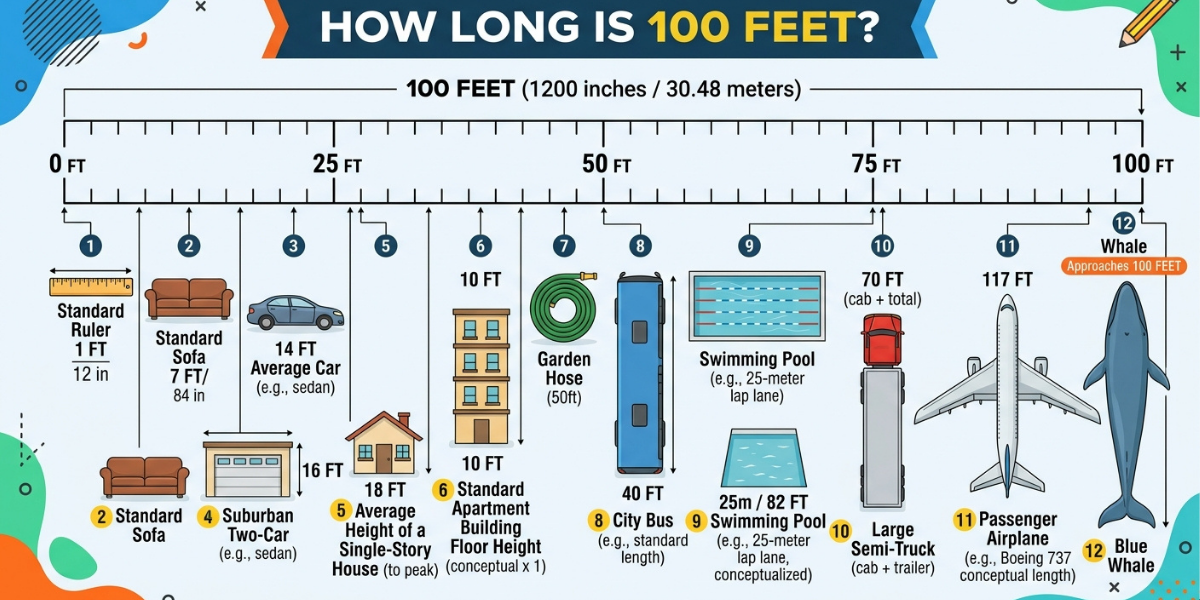
Have you ever wondered how long 100 feet really is? It can be difficult to picture this distance without seeing it in person. Although 100 feet sounds like a simple measurement, understanding its actual size becomes much easier when you compare it with familiar objects.
100 feet is equal to 1,200 inches, 33.33 yards, or approximately 30.48 meters. It is about the length of a 10-story building laid horizontally, depending on the building’s design, or roughly one-third the length of a football field.
Whether you are estimating the length of a property, planning a garden, measuring a driveway, or simply satisfying your curiosity, these comparisons can help you visualize 100 feet more clearly.
In this guide, we will compare 100 feet with 12 everyday objects and familiar structures. You will also learn how to measure this distance and convert it into other units.
How Long Is 100 Feet?
100 feet is a unit of length commonly used to measure buildings, land, outdoor spaces, and large objects.
Here are the basic conversions:
| Measurement Unit | Equivalent to 100 Feet |
|---|---|
| Inches | 1,200 inches |
| Yards | 33.33 yards |
| Meters | 30.48 meters |
| Centimeters | 3,048 cm |
| Millimeters | 30,480 mm |
A simple way to understand 100 feet is to imagine walking along a straight path for approximately 30 meters. For an average adult, this distance may take around 35–45 normal walking steps, although stride length varies considerably.
If you want to picture the distance more easily, the following comparisons provide practical examples.
12 Everyday Objects and Structures That Help You Visualize 100 Feet
The objects below offer useful reference points for understanding this distance. Some are close to 100 feet, while others need to be combined or repeated to reach the full length.
1. A 10-Story Building
A 10-story building can be approximately 100 feet tall, depending on its floor heights and architectural design.
For example, if each story averages 10 feet, ten stories would measure about 100 feet. Many residential and commercial buildings have taller floors, so an actual 10-story building may exceed this height.
Imagine laying such a building horizontally. Its approximate height would give you a useful visual reference for 100 feet.
Remember: This comparison refers to the building’s height, not its horizontal length.
2. One-Third of an American Football Field
An American football field measures 360 feet from end zone to end zone, including both end zones.
Therefore, 100 feet is slightly less than one-third of the field’s total length.
The playing field between the goal lines measures 300 feet, excluding the end zones. Compared with that section, 100 feet is exactly one-third of its length.
This is a useful comparison because football fields have standardized dimensions.
3. Five Average-Sized Cars Parked in a Row
Many passenger cars measure approximately 14–16 feet long.
If you line up five cars, each measuring 15 feet, their combined length would be:
15 × 5 = 75 feet.
That leaves another 25 feet to reach 100 feet.
You would need about six or seven typical passenger cars to cover the entire distance, depending on their lengths and whether you leave gaps between them.
This example helps you visualize 100 feet in a parking lot or on a residential street.
4. Ten Small Boats
Some small recreational boats measure around 10 feet long.
If you placed ten 10-foot boats end to end, their combined length would be 100 feet.
Actual boat sizes vary widely. Fishing boats, inflatable boats, and small recreational vessels may be shorter or longer than this example.
Still, ten 10-foot boats provide a straightforward way to imagine a distance of 100 feet.
5. Four Standard School Buses, Plus a Little More
A typical full-size school bus is approximately 35–45 feet long, depending on its configuration.
Using a 40-foot bus as an example, two buses would measure about 80 feet. Three would measure about 120 feet.
That means 100 feet is equivalent to two and a half 40-foot school buses placed end to end.
This is an easy comparison to remember when you see school buses lined up outside a school.
6. Ten Utility Poles at 10-Foot Intervals
Utility poles can vary significantly in height, and many are much taller than 10 feet. However, the spacing between selected markers can help you visualize a distance.
Imagine ten markers placed along a straight line at 10-foot intervals. The distance from the first marker to the last depends on how the intervals are counted.
For a clearer example, mark a straight path every 10 feet until you reach the 100-foot mark. You will have divided the distance into ten equal sections.
This method is useful for measuring gardens, yards, and construction areas.
7. A Large Residential Swimming Pool Area
Swimming pools come in many sizes, but some long residential or commercial pool layouts extend close to 100 feet.
For perspective, an Olympic-size swimming pool is 50 meters long, which is approximately 164 feet.
A 100-foot distance is therefore about 61% of an Olympic-size pool’s length.
If you imagine walking along the side of an Olympic pool, 100 feet would take you a little more than halfway down its length.
8. Two Tennis Courts Placed End to End, With Extra Space
A standard tennis court is 78 feet long.
Two tennis courts placed end to end would measure 156 feet, which is considerably longer than 100 feet.
One tennis court alone is 78 feet long. Adding another 22 feet would bring the total to exactly 100 feet.
This comparison works well if you are familiar with tennis court dimensions and want a reference that is shorter than two full courts.
9. Approximately Seven Telephone Poles’ Heights
Telephone and utility poles are available in different heights, depending on their location and purpose.
If you imagine seven poles that are each approximately 14 feet tall, their combined heights would equal 98 feet.
That is very close to 100 feet.
However, this is a mathematical comparison rather than a recommendation to estimate distance from actual pole heights. Real utility poles are often taller, and their dimensions vary by installation.
10. Twenty Standard Office Desks Arranged in a Line
Many office desks are approximately 4–6 feet wide.
If you use desks that are 5 feet wide and arrange 20 of them in a straight line, the combined length would be:
20 × 5 = 100 feet.
This is a practical way to visualize the measurement inside a large office, exhibition hall, or warehouse.
The actual total depends on the desk dimensions and whether spaces are left between them.
11. About 30 Meters of a Running Track
A distance of 100 feet equals 30.48 meters.
This makes it slightly longer than 30 meters, a distance that is easy to picture on a running track or an athletic training area.
For example, if you mark a straight section of a track at 30 meters, you would need to add another 48 centimeters to reach exactly 100 feet.
This comparison is especially useful for people who normally measure distances in meters.
12. Ten Sections Measuring 10 Feet Each
One of the simplest ways to visualize 100 feet is to divide it into ten equal sections.
Each section measures 10 feet, and all ten sections together make 100 feet.
You could use this approach to estimate the length of a driveway, fence line, garden, or outdoor seating area.
For example:
- First section: 10 feet
- Second section: 20 feet total
- Third section: 30 feet total
- Fourth section: 40 feet total
- Fifth section: 50 feet total
- Sixth section: 60 feet total
- Seventh section: 70 feet total
- Eighth section: 80 feet total
- Ninth section: 90 feet total
- Tenth section: 100 feet total
This is a practical method when you have a measuring tape, marked rope, or another reliable reference.
How Long Is 100 Feet Compared With Other Common Distances?
These quick comparisons help put 100 feet into perspective.
| Distance | Length in Feet | Difference From 100 Feet |
|---|---|---|
| 25 feet | 25 feet | 75 feet shorter |
| 50 feet | 50 feet | 50 feet shorter |
| 75 feet | 75 feet | 25 feet shorter |
| 100 feet | 100 feet | Exact distance |
| 150 feet | 150 feet | 50 feet longer |
| 200 feet | 200 feet | 100 feet longer |
As you can see, 100 feet is twice as long as 50 feet and half as long as 200 feet.
How to Measure 100 Feet Without a Long Measuring Tape
You do not always need a 100-foot measuring tape to estimate this distance. Several practical methods can help.
Use a Measuring Wheel
A measuring wheel is useful for measuring long, relatively flat distances. Push it along the ground, and its counter records the distance traveled.
This method works well for driveways, yards, sidewalks, and construction sites.
Use a 25-Foot Measuring Tape
If you have a 25-foot tape measure, you can measure four consecutive sections of 25 feet.
Four sections of 25 feet equal 100 feet.
Mark each endpoint carefully to avoid leaving gaps or overlapping sections.
Count Your Walking Steps
You can also estimate 100 feet by walking and counting your steps. However, this method is less accurate because everyone’s stride is different.
First, measure a known distance of 10 feet and count how many steps you take. Then repeat that distance ten times to estimate 100 feet.
Use a Digital Map
For outdoor areas, mapping applications can help estimate distances between two points. Choose a suitable straight-line or route measurement feature, depending on whether you want the direct distance or the distance along a path.
Keep in mind that a walking or driving route may be longer than the straight-line distance.
What Can You Use 100 Feet to Measure?
A 100-foot measurement can be useful in several everyday situations.
Property and landscaping: Estimate the length of a fence, garden boundary, or large lawn.
Construction: Plan outdoor layouts, estimate material requirements, or measure the distance between structures.
Sports and fitness: Visualize running distances and training areas.
Events: Estimate the length of a temporary seating arrangement, outdoor display, or queue.
Home projects: Plan a long driveway, garden path, or outdoor lighting installation.
For projects that require precise measurements, use a suitable measuring tool instead of relying on visual estimates.
Is 100 Feet a Long Distance?
Whether 100 feet feels long depends on what you are measuring.
Inside a small room, 100 feet is an enormous distance. In a large garden or parking lot, it may seem relatively short.
At 30.48 meters, it is longer than many residential driveways but much shorter than a football field. Walking 100 feet usually takes only a short time, although your pace and the terrain affect the result.
The easiest way to understand this length is to imagine ten 10-foot sections arranged in a straight line.
Frequently Asked Questions
1. How many inches are in 100 feet?
There are 1,200 inches in 100 feet. One foot contains 12 inches, so multiplying 100 by 12 gives 1,200 inches.
2. How many meters is 100 feet?
100 feet equals exactly 30.48 meters.
3. How many yards are in 100 feet?
There are approximately 33.33 yards in 100 feet because one yard equals 3 feet.
4. How long does it take to walk 100 feet?
For many adults, walking 100 feet takes approximately 15–25 seconds at a comfortable pace. The exact time depends on walking speed, stride length, and the walking surface.
5. Is 100 feet longer than a football field?
No. An American football field is 360 feet long when both end zones are included. Therefore, 100 feet is considerably shorter than the entire field.
6. How many cars fit into 100 feet?
If each car measures approximately 15 feet long, six cars would occupy 90 feet, while seven would occupy 105 feet. The exact number depends on vehicle size and the space between cars.
7. How can I picture 100 feet easily?
Imagine a straight line divided into ten equal sections, each measuring 10 feet. Alternatively, picture a 30.48-meter distance or roughly one-third of an American football field’s total length.
8. Is 100 feet the same as 30 meters?
Not exactly. Thirty meters equals approximately 98.43 feet. One hundred feet is 30.48 meters, making it 48 centimeters longer than 30 meters.
Final Thoughts
So, how long is 100 feet? It is 30.48 meters, 33.33 yards, or 1,200 inches.
Comparing it with buildings, sports facilities, cars, desks, and marked sections can make the distance easier to understand. The most reliable everyday reference is to imagine ten consecutive sections of 10 feet each.
Whether you are planning a home project, estimating an outdoor space, or simply curious about measurements, these examples provide a practical starting point.
For accurate results, always confirm important distances with a measuring tape, measuring wheel, or another appropriate tool.
Leave a Reply